
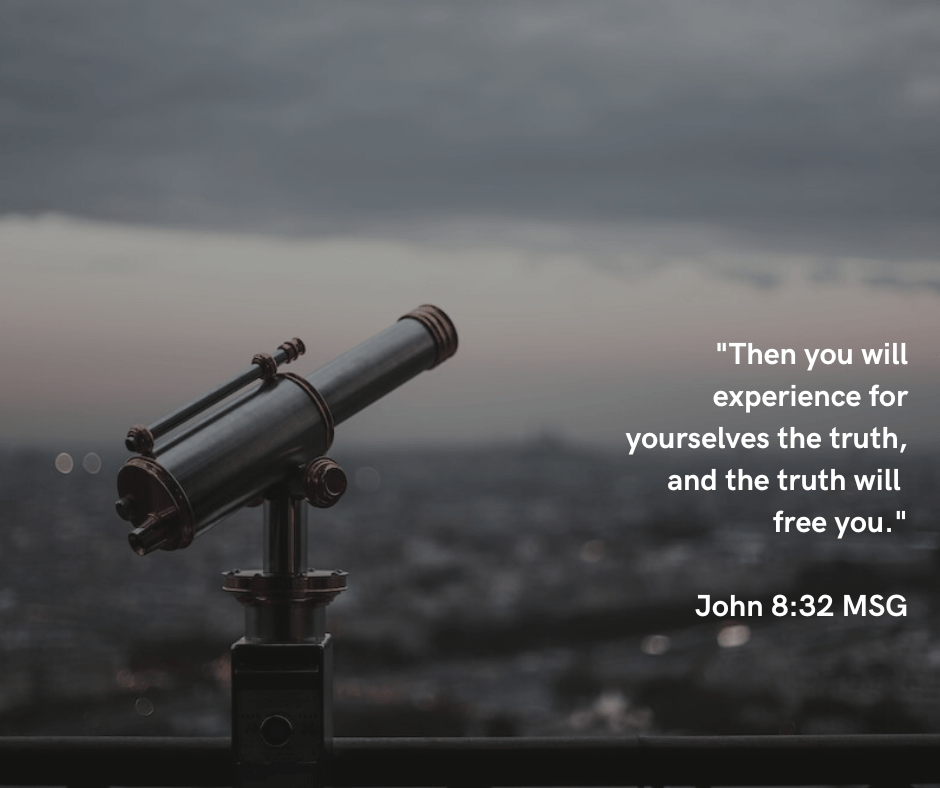
Many people do not realize that Pontius Pilate asked, “What is truth?” during his inquest of Jesus Christ. That question was undoubtedly pertinent to that hour and has not diminished in importance despite the time. Many folks from many walks of life still quarrel with the answer. How this question is answered by a person reveals how they live and die and what they value. Webster’s definition of the word truth reads, “Conformity to fact or reality; exact accordance with that which is, or has been, or shall be.” The Oxford dictionary defines truth as “the true facts about something, rather than the things that have been invented or guessed.”
Recently there has been a revival of an old game show on T.V. entitled “To Tell The Truth.” It consisted of a panel of 3 celebrity guests, a host, and 3 special guests, all claiming the same identity. The panel posed questions to the guests for a short period, and when the time was up, they had to decide who they thought was the natural person in question. I raise this example because it is a great way to emphasize that for the person of faith, truth is not a set of facts but a person, and that person is Christ.
We live in a culture now that teaches that one person cannot contain all the truth in the world. It also conveys that truth is not absolute. That it can vary depending on the circumstances. This manifests in words like, “Well, that might be true for you, but that’s not true for me.” We are also exposed to the idea that truth is subjective and can change over time. Once again, this is biblically untrue because the word of God tells us that God never changes. Malachi 3:6 states, “I am the Lord God, and I change not.” Therefore, the truth that He has imparted to us does not change. I find this comforting in these days where everything changes constantly.
To get a deeper grasp on this idea, I look at the difference between true and accurate words. What is true is about perspective and circumstance. Truth is absolute. This often has to do with feelings. Feelings are not truth., though they may reflect true things. For instance, I may tell someone they have hurt my feelings in a relationship. While this seems true to me, it is based on perspective. This leads me to understand that absolute truth is not experienced either. This is a dangerous trap for my mind to fall into. Why? Because I can start making decisions and base my values on my perspective and experience. Things that may or may not have anything to do with God’s truth. If I compare my experiences to my husband, they are vastly different. How do we raise our children? This is why biblical truth is so important. It is foundational in that it puts our experience and feelings into the proper place, and we live our lives, base our values, and make choices on God’s standards and not
our own. This is how we tried to raise our kids.
After recognizing truth is not feelings, not experience, I must accept that truth is not logic, contrary to the world’s intellect. It cannot be arrived at by reason alone because it requires faith. Faith is unreasonable to the science department. It says there must be a process and a consistent, repeatable logical conclusion; if so, this is true. Faith is about what we don’t see and what we hope for. This is solely God. While many folks come to Christ in faith, they struggle with maturing in their faith because they are ruled by logic alone. It wasn’t logical for Noah to build an ark though it had never rained. The virgin birth does not hold up to scientific criteria yet, but I believe it with all my heart. I believe it because it is based on the truth of God, His character, and His word. God tells us in His words that His ways are not ours and His thoughts are higher than ours. Therefore this reveals to me my limited human logic does not compare to the intellect of God. God’s thoughts, ways, and actions are all examples of His truthfulness and cannot be separated like the yolk from the white of an egg.
This logical approach to truth can incredibly impact giving and sharing with others. It wasn’t logical for the Good Samaritan to stop and help. We can reason our way out of serving others with the love of Christ because it just doesn’t make sense to us. However, this is contrary to God’s truthful command for us to put others ahead of ourselves and help those in need. It doesn’t seem logical that we could support ourselves while tithing. Ask your money guy. He might often tell you it is more logical to put those funds in an IRA for retirement, but once again, this moves us away from the illogical miraculous way God blesses us as His children when we keep Him first in this area.
Then I examine Philosophy. Is this true? Hardly. It is defined as the activity people undertake to seek an understanding of fundamental “truths” about themselves, the world in which they live, and their relationships with each other and the world. Wow, that’s a mouthful, right? While our philosophy can be based on truth by itself, it is not truthful unless it is based on God’s word. Otherwise, it is a conglomeration of our feelings, logic, and experiences. I have already discovered this is a big trap for me. It is the most subtle of all things that will side-track me from God’s truth. It leads me in a pursuit that flatters me, is centered on me, and satisfies me. It is at the heart of unbelief and pride. It attempts to erect me and others like me to buy in that we are somehow equal to God. If you have read the bible for more than a minute, it won’t take long to understand this is a lie. Herein lies the struggle.
Many times I want to settle for a palatable truth. Something watered down, easy on my lifestyle, doesn’t trouble my mind, doesn’t call for conformity or change, or self-examination. Part of me wants to be in agreement with the world, to be its friend, Engage in intellectual pursuits, and trust in science alone. But as a disciple of Christ, if I pursue this avenue, I will never experience the peace referred to as the “peace that passes all understanding, peace that defies logic.”
Finally, I must also come to believe in my heart that truth is not just information. Often, when I am troubled by something, praying about it, I attempt to gain as much intel as possible about my struggle. I analyze, review, seek opinions of others, etc. While all of these can be good, on their own, without the truth of God, they merely inform me but don’t bring the resolution my soul and spirit need to move ahead. Because the bible tells me that truth is a person, I have learned to accept that until I have heard from the Holy Spirit, I have not heard the whole truth and nothing but the truth. When he speaks to me, I will be more than informed; I will be enlightened and inspired. And I gain the confidence that I am now operating with the proper perspective about my situation. His voice trumps my emotions, experience, feelings, and information.’
The scriptures promise us that the truth, who we are told is God incarnate, Jesus, is what makes us indeed free. Free from the worry that we don’t know the truth from a lie. Free from the doubt that we haven’t got it right in life, free from the fear of the future when we make life’s tough decisions based on God’s truth. It ends our struggle for the unrelenting search for a solid foundation. We enter rest when we accept the truth. Especially when it comes to our relationship with a holy God. Without accepting the fact that God came down in the flesh to relate, restore and return me to a heavenly eternal home, if not for Christ, I would be settling for the lie that God will accept my good deeds and intentions and will lend His ear to my version of the truth about myself. Finding the truth is finding Christ. Finding Christ is finding redemption, and finding His redemption is finding the life we all struggle to discover.
Jesus, you are truth in the flesh. Your words and ways are true. Help me to understand that my struggle is more about belief than it is about intellect. Give me the faith that satisfies my soul to stop searching for more truth when I have all I need in you.
Join me next time when the 5 o’clock worker continues to examine the struggle in daily life in the vineyard with “Prayer and Finding Answers”
 5oclockworker.com