
Recently while doing some genealogy research, I came across the information that Finland, for the 6th year in a row, was identified as the happiest nation in the world. Since I am 50% Finnish, I decided to go down the rabbit hole and see what lies behind this claim of” happiness.” Some of the reasons the Finns gave were low corruption, high social support for families, and good quality of financial compensation for employment. Scientists also claim that the people of Finland genetically have a predisposition for happiness in general. By the way, America ranked 15th. Looking at this information, I discovered the popularity and how often “happiness” was googled. In 2020, the search reached an all-time high during the pandemic, along with the word ” hope.” Happiness and what brings it are central in the mind of culture. In America, the preamble of the Declaration of Independence mentions the right to pursue it. Bobby McFerrin, back in 1984, gave us a song to encourage the culture to embrace a better state of mind with these simple words “Don’t worry, be happy.” If it were only so easy, right?
This made me look closer at the word “happy” since the first in this new series of devotions is on the Beatitudes found in Matthew 5. I have noticed that some translations use the word “happy” instead of blessed but never really examine why. Though the word is “Blessed” in the original language, it has a deeper and more poignant meaning that also encompasses the concept of happiness. When we read the Beatitudes, the word “Blessed” is multi-dimensional. It implies divine impartation for these characteristics but also gives us a word picture of happiness for those who engage in these behaviors. The Beatitudes are statements and imply a promise for the future. Many of us read the Beatitudes and often think as we progress through them that Jesus is identifying a cast of different people with certain characteristics or a penchant for certain behaviors.
So we often interpret, “Happy are those who are poor in spirit or Happy are the peacemakers,” as only those with the natural tendency for these characteristics will be happy or blessed. We disqualify ourselves by thinking that some of these don’t apply to us personally. For instance, I might never be totally happy because, by nature, I am not a peacemaker. Therefore, I may never be referred to by others as a child of God. This could not be further from the truth. The Beatitudes are not multiple choice, nor are they offered as a cafeteria plan for being blessed or happy. Rather, they are given to us by the Lord as identifying traits of being a disciple of His.
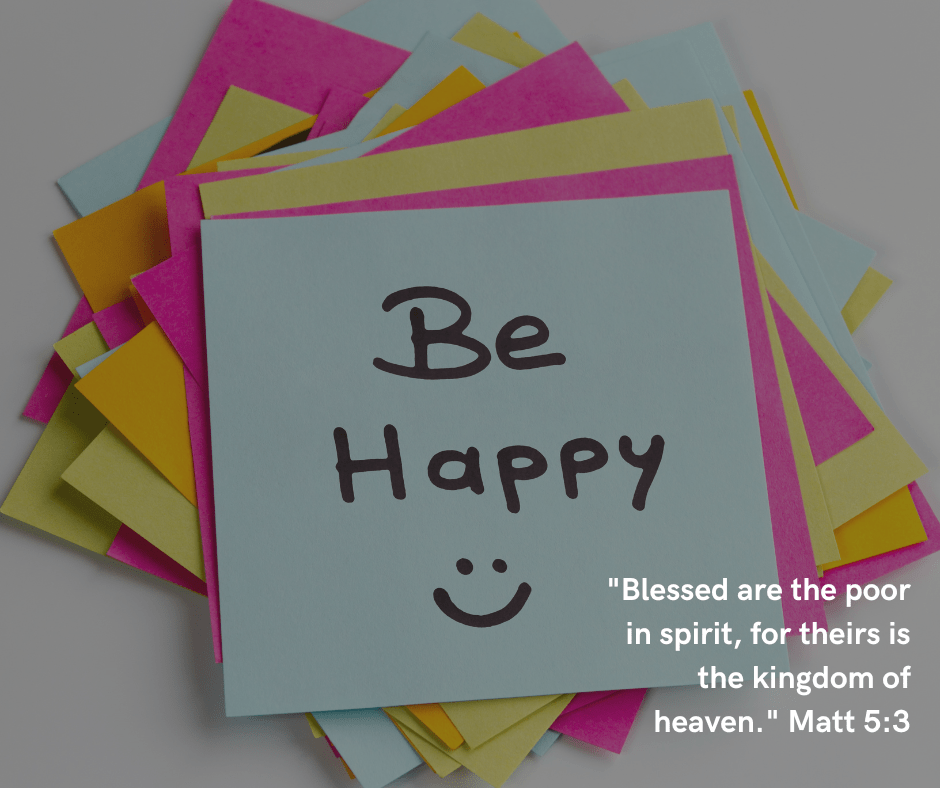
This is more evident when I read the first Beatitude (Matt 5:3 ). It states, “Blessed are the poor in spirit for theirs is the kingdom of heaven.” This is foundational in that in order to follow Christ as the true Messiah, I must first and foremost understand the state of spiritual poverty I am in without Him. When I confess my “bankrupt condition” to Him, it gives me access to Him and the eternal life He offers in the kingdom of heaven. Blessed by the grace He imparts, as a result, true happiness can be secured.
Blessed are those that mourn, for they shall be comforted. This promise is not just for those in a temporary season of grief. The promise tells me there will be no loss I will face where God will not or cannot comfort me. As His child, it will be divinely supplied when I need comfort. Though I will grieve many losses throughout life, people’s dreams, and face hurts and betrayals, this promise is connected to the hope that, ultimately, God will wipe away all tears. I may not always feel happy, but ultimate happiness is mine as an inheritance.
Blessed are the meek, for they shall inherit the earth. This means a disciple of Christ will express an enduring attitude of humbleness, not arrogance. It does not imply that a Christian will be a doormat, but rather it will not be easily offended on behalf of self. It means that a faithful follower committed to the ways of Jesus will exercise self-restraint. Within this statement, we find the promise of reward that true humility and lowering our cause for the self-ego will result in the position to ultimately reign with Him.
Blessed are those who hunger and thirst after righteousness, for they shall be filled. This is where, once again, blessedness and happiness meet up. Jesus promises if I am seeking a life based on His righteous path, it will not result in a disappointing unhappy outcome. He promises I will be satisfied. Blessed fulfillment supplies a contented heart.
Blessed are the merciful, for they shall obtain mercy. Unforgiveness is the root of unhappiness across the board. I am promised an endless supply of forgiveness because I have experienced the forgiveness of God through Christ and the cross. I need to lavish it on others as freely as he has lavished it on me. Ouch!
Blessed are the pure in heart, for they shall see God. This speaks of a heart condition without guile or evil intent and motive. I think of a child when I read this. Think of how children are so happy and carefree, born out of an innocent heart. They see good almost in everything. Seeing good all around me only comes from witnessing the purity God offers me and embracing and applying it. The more I engage and allow it to saturate me, the more I will see it evidenced around me. I call it secret x-
ray vision.
Blessed are the peacemakers, for they will be called the children of God. Oh, to have such an identity in a warring world where it seems we are in eternal debate and argument. The mark of a disciple is the divine ability to diffuse a situation. Do I contribute to conflict around me by taking up an opinion that satisfies ego and self rather than letting love be my highest aim? Can I embrace folks lovingly without embracing their cause if it is not righteous? Will I speak on behalf of the Lord and attempt to bring value to others, even amid awkward or uncomfortable circumstances? Can I maintain my contentment in Christ while others around me will not or cannot for whatever reason?
Blessed are those who are persecuted for doing right, for the kingdom of God is theirs. He informs us that others will be against us and even lie about us. He even us this is not a new problem and that the prophets of old encountered the same challenges. Note that Jesus comes full circle in His teachings in that He started with promising the kingdom of heaven to those who are spiritually impoverished and closes out the beatitudes with a promise to do right. Once we come to Christ, follow after Him, and seek to be embraced and conform to His ways, Jesus promises us a rich inheritance. For a believer, the things others confess in this world that bring happiness are not ultimately sustainable. They are fragile and dependent on human sources that tire, change, and fail. The words come to me… these, too, shall pass. Experiencing the blessings of being a child of God and a disciple of Jesus Christ is the only path to true happiness that will last. Eternal reward. Jesus Himself uses the word Great! It must be significant if the Master of the universe uses the word Great!
When I start feeling unhappy and get down with what I call valley vision, when I find myself envious of the life that others may be experiencing from my self-pitying perspective, I need to ask God to help me regain a mountaintop perspective which is what Jesus provided that day. He told me I was blessed and that the life He promises has desirable outcomes; if I remember, I am blessed. Happiness can be mine. He said so!.
Jesus, let me take you at your word. Remind me all these teachings are for me, not just a few select statements. Redefine and remodel my concept of a happy life and what happy endings look like.
Come back next time when the 5 o’clock worker examines the danger of low sodium in “A Salty Spirit” when the series Moments on the Mountain continues.
 5oclockworker.com
So good. Learned new phrase, “valley vision,” which we all experience
LikeLike