
Sometimes when I begin a project, especially one that requires what is referred to as “elbow grease,” I can get overwhelmed and talk myself into putting the project off. One of my least favorite household tasks is cleaning out the garage. Because in South Carolina, where I now reside, they don’t have basements. So, as a result, my garage is the catch-all from everything to yard tools and Christmas decorations. The door leading to the garage is right off the kitchen, so I see our “stuff” regularly. I can hear all the super organized folks saying everything must have a place, but trust me, it’s a problem when you have more stuff than a place. Of course, I could write a devotional on accumulative materialism, but that’s another story. Ultimately, the mess calls, and we roll up our sleeves, and the first thing we do is the survey. We stand around on a Saturday morning, gaze over our belongings, sigh a little, blame a lot, and begin redesigning the space to accommodate what needs a place and part with what “doesn’t bring us joy.” There have been a few times where we just closed the kitchen door and made other plans because the survey said: “not today.” After all, why ruin a perfect Saturday, right?
Maybe it’s not your garage, but it’s redoing a bathroom or a large repair. Perhaps it is a new direction in a career or relocation or retirement. It could be helping start a neighborhood bible study or launching another new ministry God has placed on your heart. For some, it may be the commitment to undertake the resolution and healing of a marriage or a family, or a church. Whatever task lies before any of us, the moment of elbow grease application comes at the end of the survey when we really take a look at what lies before us.
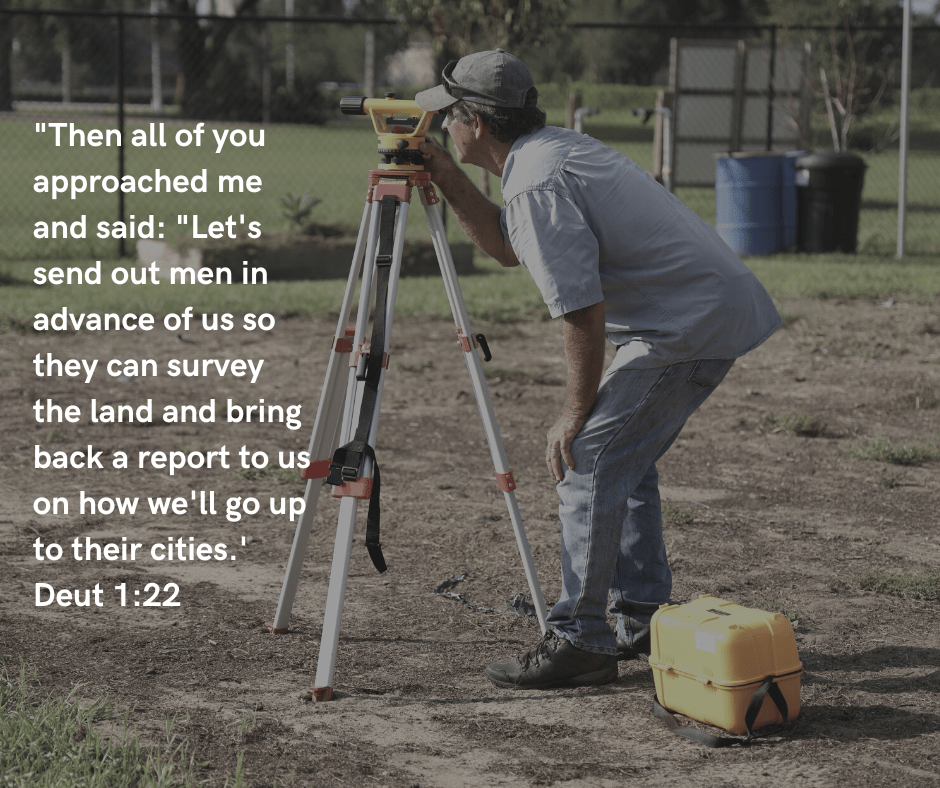
When we go to scripture, and look at the importance of surveying before a project, we see the challenge placed before the Israelites by Moses, before conquering the promise land. “Then all of you approached me and said: “Let’s send out men in advance of us so they can survey the land and bring back a report to us on how we’ll go up to their cities.’ (Deut 1:22) Nehemiah faced a similar tasked when he arrived in Jerusalem, and though he had already left his secure job, he had to travel about 800 miles (scholars estimate about 30 miles a day) to survey the city and the wall in its pile of rubble. Before he even arrived, Nehemiah began to face opposition. In the latter part of the second chapter of Nehemiah, the scriptures record that Sanballat and Tobiah received word of the Reconstruction and began to oppose the project. The political landscape was such that neither of these 2 men wanted the wall rebuilt and the city restored due to the fact that, as Samaritans in leadership, they did not want returning exiles to take control of the land.
Secondly, Nehemiah was no ordinary exile; he was a personal advisor and cupbearer to the king of Persia. Thirdly, there was already bad blood among the exiles and the samaritans due to previous attempts to rebuild the wall by a man named Zerubbabel. So the task of rebuilding is getting more challenging by the day.
However, Nehemiah exercises wisdom that we can all learn from when facing tough tasks; Nehemiah uses discretion. He doesn’t arrive in fanfare, doesn’t march down the main street, or call a press conference to announce his intent or the plans God had given him to rebuild. Instead, he waits 3 days, slips out at night as 2:12 reveals, and takes only a few workers and 1 donkey. Nehemiah could perform the survey discreetly, unnoticed, and as a result, unchallenged for the moment. Giving the enemy a foothold by revealing your intent and plan is unnecessary and unwise. When we are on assignment from God, there will be enough opposition as it is without us inviting it.
If you have ever been to a war-torn or third-world country, this would only give you a glimpse of what Nehemiah discovered in the survey. He reports that the rubble was so great at the Kings pool and the Fountain gate that his donkey could not navigate. Here is the practical side of the logistics Nehemiah faced. The distance of the wall was about 2.5 miles long. The average height would have been greater than 30 feet and the thickness greater than 8 feet. There was a need for over 30 watch towers, and at least 9 gates were destroyed. When you look at these numbers multiplied by the time the city and walls had been in disrepair, we can only barely grasp how demolished and destroyed the landscape was. Think of all the rubble that would have been removed (think demo day) before rebuilding could occur.
It’s enough to make any of us shut ” the proverbial kitchen door” and run for the hills. This reminds me how vitally important it is to see Reconstruction through the eyes of our great God. I see obstacles. He sees opportunity. I see nothing but problems and headaches; he sees purpose. I begin to hum the dirge of failure while God is blowing the trumpet of triumph and victory. God doesn’t need the wall rebuilt to keep His people safe. He wants to display His great love and provision and begin the restoration project among His people. I have heard it said that very often, in a spiritual lesson, there is a physical aspect that always presents itself as a model to teach the principle. I believe this is true when it comes to the rebuilding of the wall. It’s a physical picture of the rebuilding of a people and the restoration of their relationship with God. I also see this clearly in the life of Nehemiah. He would physically have to see the rubble and destruction and continue to remember that the “gracious hand of his God was on him still” In 2:18, Nehemiah shared this with the Jewish leaders, priests, and officials after he had surveyed the entire project. Only eyes of faith in a trustworthy God could inspire the people to rebuild. As a result of this vision, the people committed to rebuilding the wall.
The number of scriptures recorded about the eyes of God is too numerous to list. But it is a worthy search for me to be reminded that the vision of God is never limited nor distorted. He neither requires binoculars nor night goggles to aide Him, and His sight transcends time and space. There is nothing He assigns me that He will find overwhelming or impossible. While I am living out Reconstruction in the daily, God sees in me the finished work of Christ, the new creature that was rendered by grace through love.
Lord, Just help me not to be overtaken by what I see with my eyes. Keep me from dreading Reconstruction and give me “greasy elbows” to stay at the task you assigned. Let me apply discretion speaking only when and how you want me to when it comes to your plans for my life. When I survey something, let it be the wondrous cross. And remind me of the outcome.
Come back to the vineyard where next time the 5 o’clock worker sees how the value of teamwork makes an impact as the series in Nehemiah continues “Under Reconstruction.”


I have been in those shoes and readily recognize myself. This week has been the office with the shredding of papers and reorganization. Thank you God for pushing me on. Amen.
LikeLike